
Compare Cheap Flights from Beijing, Shanghai and Across China

Popular Cities to Fly to from China in 2026
From a weekend in Tokyo to a long trip to Europe, one search from Beijing or Shanghai shows which seller has the lowest fare



















Welcome to TICKETS!
TICKETS brings the fares of airlines and booking sites worldwide onto one page, so travellers in China can see in yuan who sells the same seat for less and then book with that seller directly.
About TICKETS.中国Cheap Flights from the Airports Closest to You
Departures from your nearest airport are priced automatically, starting with the most popular countries

Beijing Daxing
Dec 2026
1+ Stops
One Way
San Francisco International
Dec 2026
From
¥2K
Beijing Capital
Dec 2026
1+ Stops
One Way
Los Angeles International
Dec 2026
From
¥3K
Beijing Capital
Dec 2026
1+ Stops
One Way
New York John F. Kennedy
Dec 2026
From
¥3KBeijing Capital
Dec 2026
1+ Stops
One Way
Harry Reid
Dec 2026
From
¥3KBeijing Capital
Dec 2026
1+ Stops
One Way
San Jose International
Dec 2026
From
¥3KBeijing Daxing
Dec 2026
1+ Stops
One Way
Denver International
Dec 2026
From
¥3K
Beijing Capital
Dec 2026
1+ Stops
One Way
Seattle / Tacoma International
Dec 2026
From
¥3K
Beijing Capital
Dec 2026
Nonstop
One Way
Los Angeles International
Dec 2026
From
¥3K
Beijing Capital
Dec 2026
1+ Stops
One Way
Atlanta Hartsfield-Jackson
Dec 2026
From
¥3KBeijing Capital
Dec 2026
1+ Stops
One Way
Detroit Wayne County
Dec 2026
From
¥3KWhere Can You Fly from China? Explore by Continent
Choose a continent, then a country, to see the lowest fare we have found from Beijing, Shanghai and other cities in China






Low Fares to Cities Travellers from China Love
Pick a city to see the cheapest way to get there from Beijing or Shanghai








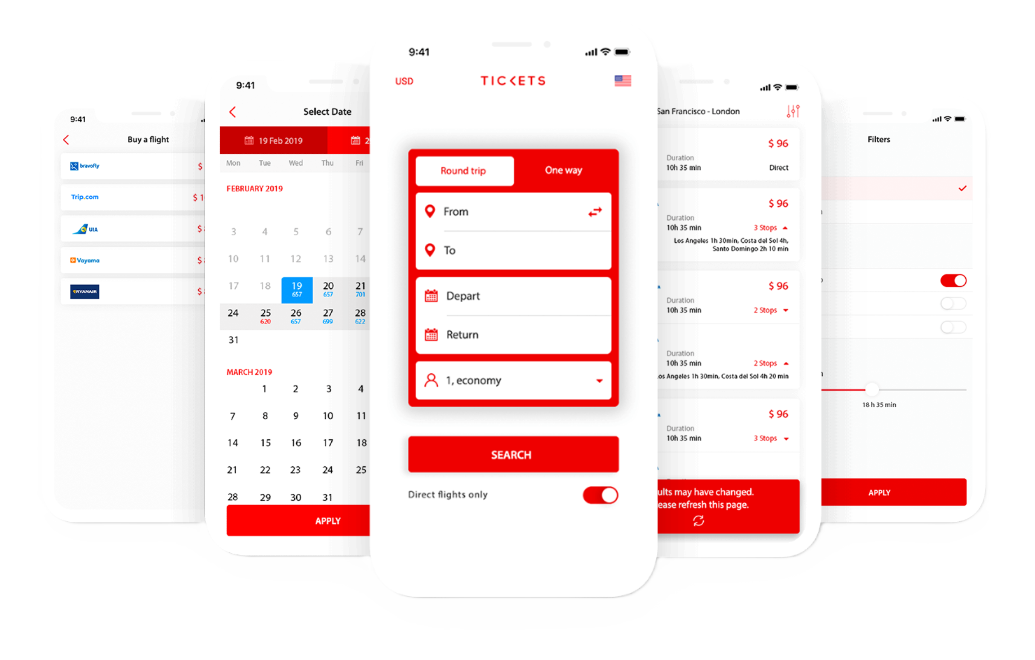
Check fares on the move. The free TICKETS app for iOS compares 1,200+ airlines and booking sites in real time, saves your trips and watches prices for you, all without creating an account.
Paying less for flights from China: a practical guide
When is the best time to book a flight from China?
For short and medium-haul trips, such as a week in Japan or Southeast Asia, aim to book about one to two months before departure; around six weeks out is often a good point. Buying much earlier rarely makes the ticket cheaper, so the idea that you should always book as early as possible doesn't hold for nearby destinations. Long-haul flights to Europe, North America or Australia are different and generally reward booking a few months ahead. From China, the holiday calendar matters as much as distance: around Spring Festival, the May Day break, the summer holidays and the October Golden Week, seats go quickly and prices rise, so book those dates well in advance. Since fares change many times before departure, there's little point hunting for one perfect day. Set a price alert instead and keep an eye on the route while your plans take shape. One rule nearly always holds: don't leave it to the last two weeks, when fares rise fastest. If you can't tell whether today's price is good, let an alert tell you when a genuine drop arrives.
Is booking very early from China always cheapest?
Not usually. Buying the moment a flight goes on sale is often one of the more expensive ways to book. For short-haul trips, fares several months out tend to sit above the cheaper middle period, drift down towards a low point roughly six weeks before departure, then rise again as seats fill up. So the very early and the very late ends both cost more, and the best value usually lies in between. Long-haul routes and holiday periods are the exception. For summer flights to Europe or North America, or any trip over Spring Festival or Golden Week, seats really do run out, and booking a few months ahead protects you from both high prices and sold-out flights. In short: for nearby trips there's no need to buy on day one, while for distant destinations and busy holidays you should book earlier. If you're unsure, set an alert and let the price guide you rather than paying extra for buying too soon.
Which day of the week is cheapest to fly from China?
Departing on a weekday, especially mid-week, is usually cheaper than leaving at the weekend, when leisure demand is at its highest. The days just before and after a public holiday week also tend to be busy, so check those dates carefully. The exact cheapest day varies by route and season, so 'travel mid-week, avoid weekends' is a better rule than fixing on one particular day. On short, inexpensive flights the difference is modest; on long-haul trips, moving a departure off the weekend can make a more noticeable difference per person. Keep the day you fly separate from the day you buy: the old advice to buy tickets on a Tuesday no longer applies, because airline prices now update continuously rather than once a week. What still counts is the day you travel, not the day you pay. We show a price grid for the whole month, so you can see at a glance which departure days are cheapest for your route instead of guessing.
How does TICKETS.中国 find a round trip cheaper than one airline offers?
When you search for a round trip, you see more than standard return tickets: we also build the cheapest combination for you. Behind each search we price the outbound and the return as separate one-way flights and pair the cheapest flight out with the cheapest flight back, even if they are with different airlines. That combination often costs less than any single airline's round-trip fare, because no one airline is cheapest in both directions. You get the benefit of two one-way tickets without doing the work yourself, as we combine them and show them as one result. We only show this option when it really is cheaper than the best normal round trip we found, and we show exactly how much less it costs. If a standard return costs the same or less, we show that instead, because a split booking means a little more effort, with two confirmations and two tickets, and is only worth it when it saves you money. The choice stays clear, and the lower total is always the default.
Are two one-way tickets cheaper than a return from China?
Often, and with us you don't have to work it out, because every round-trip search already checks. The cheapest way out of Beijing or Shanghai might be with one airline and the cheapest way back with another, so two separate one-way tickets can add up to less than a single return fare. The traditional approach was to search each direction yourself and piece the best pair together, which takes time and is easy to get wrong. We do it inside the search: each direction is priced separately, the cheapest outbound and return are paired, and the result appears as one option with the difference spelled out. You only see it when it beats the best standard round trip. Keep in mind that a combined trip means two bookings on two tickets, so you confirm each flight separately and deal with each seller on its own if anything changes. For a simple there-and-back trip on separate dates that's rarely a problem, and the lower price is yours.
How much difference do flexible dates make from China?
Being flexible with your dates is often the most valuable thing you can do, worth more than any day-of-the-week trick. Flexibility lets you combine several advantages: travelling mid-week instead of at the weekend, and in a quieter month instead of a holiday period, can take a real share off the price of a peak-time ticket. For travellers in China, steering clear of the busiest weeks, namely Spring Festival, the summer school holidays and the National Day Golden Week, is the single biggest lever, because demand and fares peak together at those times. Which months are cheapest still depends on the route and region, but the principle of avoiding obvious peaks holds almost everywhere. By comparison, choosing the cheapest weekday makes much less difference on an inexpensive route. That's why a calendar showing prices across a whole month beats searching one date at a time. Our date picker shows the lowest available price on each day and covers several months ahead, so low-price dates stand out immediately. If your dates can move even slightly, that flexibility will usually do more for your budget than any other tactic.
Can a different departure airport make flights from China cheaper?
Sometimes, yes. Beijing and Shanghai each have two major airports, Capital and Daxing in Beijing and Pudong and Hongqiao in Shanghai, and the same trip can be priced differently depending on which one you use. Elsewhere, a smaller airport within reach of your home may offer a lower fare than the nearest big hub. Count the whole cost, though: a cheaper ticket from an airport further away only makes sense once you add the train or taxi fare and the extra time. It's usually worth it when the price difference comfortably covers those costs. Many search tools only show neighbouring airports if you ask, so plenty of travellers miss these options. We detect the airports nearest to you so a cheaper departure close by isn't overlooked, and our destination map lets you scan prices from your area at a glance. Before booking, compare the door-to-door cost, not just the fare. If the other airport still comes out cheaper, it's an easy win.
What is a self-transfer itinerary, and what are the risks?
A self-transfer, sometimes called virtual interlining, links two separate tickets, often on airlines with no agreement between them, into one journey. It can cost noticeably less than a single through ticket, but no airline stands behind the whole trip. The main risk: if your first flight is late and you miss the second, the second airline has no duty to rebook you; you count as a no-show and may need to buy a new ticket. You also collect your bags and check them in again between flights, and passenger protection applies to each ticket separately, so a missed connection on separate tickets is generally your problem. When changing planes abroad, check whether your passport needs a visa or transit permit to leave the airport, as collecting your bags may mean entering the country. If you build such an itinerary yourself, leave a generous layover, a few hours with hand luggage only and more with checked bags or a change of airport, and consider insurance that covers missed connections. The cheaper a self-transfer looks, the more one missed flight could cost you, so weigh the risk and not just the fare. We show valid options and their trade-offs so you can decide with your eyes open.
Do price alerts really help travellers in China pay less?
Yes, mainly by helping you react quickly rather than trying to predict the future. A flight's price changes many times before departure, sometimes by a lot, so trying to pick the perfect day is guesswork, whereas an alert tells you when a route you care about actually gets cheaper. That makes timing simple: set an alert, then buy once you're in the usual cheap booking window or when a real drop arrives. Alerts are most useful if your dates are flexible, if you're booking well ahead, or if you're watching long-haul routes to Europe or North America, where prices move more. Their weak spot is very short flash sales, which can end before any alert goes out, so the rare mistake fares still need some luck. With TICKETS.中国 you can set free alerts on the routes you're watching; we check prices regularly and let you know when something changes, so you don't have to repeat the same search every day. It's a dependable tool, not a fortune-teller.
Should I book my flight from China now or wait?
It depends on how today's price compares with the route's own history, and that's exactly what our 'book now or wait' guidance answers. We look at about twelve months of prices for your route and give one of three recommendations, buy now, wait or neutral, each with a confidence score and a plain explanation, along with the cheapest and most expensive months and whether prices are rising, falling or stable. A rule of thumb that fits the price history: if you're within the usual cheap booking window, roughly six weeks ahead for shorter trips and a few months for long-haul, and the price is at or below the route's normal level, book. If it's still early and prices look high for the season, waiting may pay off. Around Spring Festival and Golden Week, though, waiting is rarely a good bet. The clearest signal is to avoid the final couple of weeks, when fares climb fastest. If in doubt, set an alert and let a genuine drop decide for you.
How does TICKETS.中国 make money if it's free?
We don't charge you anything and we don't add a markup to fares. The price you see is the airline's or travel agent's own price, passed on unchanged. When you click to book, we send you straight to that airline or booking site to complete the purchase, and the seller pays us a small commission for the referral. That commission comes from the seller, not from you, and it's the same whether you choose the cheapest option or a more expensive one, so we have no reason to point you anywhere except the best deal for your trip. Comparing flights, using the price grid, exploring destinations and setting price alerts all cost nothing. That's how honest flight comparison works: we only earn when a booking is actually completed, which keeps our interest aligned with finding you a lower price. There's no membership, we charge no booking fee, and no hidden surcharge is added to the fare. You pay the seller's price; the seller pays us a referral fee.
Which month is cheapest for flying from China?
The lowest fares usually turn up in the quieter periods between the big holidays, and choosing such a month tends to matter more than any day-of-the-week trick. For travellers in China, the year has a few clear peaks: Spring Festival in January or February, the May Day holiday, the summer school break in July and August, and the National Day Golden Week at the start of October. Demand and fares are highest around those dates. Weeks away from them, for example after the Spring Festival rush or between the summer holidays and Golden Week, are often noticeably cheaper. Which months are cheapest still depends on the route, the region and the destination's own seasons, so a beach resort's high season or a big festival abroad can change the picture. The practical point: if your trip can move by a few weeks into a quieter period, that one decision will usually do more than picking the best weekday or chasing a magic booking day. Our month-view price grid makes cheaper periods easy to find for any destination, so you can see where the lows fall on your route.